


You encounter the term pharmaceutical intermediate when you look into how sleep disorder medications are made. This substance acts as a building block in the creation of drugs that help you sleep better. High-purity intermediates keep these treatments safe and effective. If you work in healthcare or want to learn about your medicine, knowing about these intermediates helps you make informed decisions.
Key Takeaways
- Pharmaceutical intermediates are essential building blocks in the production of sleep disorder medications. They help create the active ingredients that aid sleep.
- High purity in pharmaceutical intermediates is crucial. It ensures that sleep medications are safe and effective, reducing the risk of impurities affecting the final product.
- Understanding the difference between pharmaceutical intermediates and active pharmaceutical ingredients (APIs) helps you make informed decisions about medications.
- Choosing trusted suppliers for pharmaceutical intermediates guarantees high quality and compliance with safety standards, which is vital for effective treatments.
- Awareness of the role and importance of pharmaceutical intermediates can empower you to advocate for better sleep disorder treatments.
What Is a Pharmaceutical Intermediate
Definition and Key Features
You might wonder what a pharmaceutical intermediate is when you read about sleep disorder treatments. This substance acts as a crucial building block in the process of making medicines. Manufacturers use pharmaceutical intermediates to create the final active ingredients that help you sleep better. These intermediates do not have any direct therapeutic effect on your body. Instead, they serve as important steps in the journey from raw materials to finished drugs.
Here are some key features you should know:
- Pharmaceutical intermediates are often complex organic compounds.
- You will find them produced in large quantities to support drug manufacturing.
- They must meet high standards for purity and quality.
- You cannot use them directly as medicine.
Tip: High-purity pharmaceutical intermediates help ensure that sleep disorder medications work safely and effectively.
Difference from Active Pharmaceutical Ingredients
You may see both pharmaceutical intermediates and active pharmaceutical ingredients (APIs) mentioned in drug development. These two play different roles. Pharmaceutical intermediates act as precursors, while APIs provide the actual therapeutic effect.
The table below shows how they differ:
| Feature | Pharmaceutical Intermediates | Active Pharmaceutical Ingredients (APIs) |
|---|---|---|
| Role in drug development | Serve as precursors in the synthesis of APIs. | Responsible for the therapeutic effects of a drug. |
| Chemical properties | Often complex organic compounds with varying properties. | Well-defined compounds with known structures and activities. |
| Production and quantity | Produced in large quantities, focusing on high yields. | Produced in smaller quantities, requiring stringent controls. |
| Regulatory considerations | Not subjected to strict regulations but must comply with GMP. | Subject to rigorous regulatory scrutiny and quality standards. |
| Application and use | Not used directly in therapy; serve as starting materials. | Active components that interact with the body for therapeutic effects. |
You can see that pharmaceutical intermediates do not provide any direct benefit to patients. They help scientists and manufacturers build the final medicine. APIs, on the other hand, are the parts of the drug that actually help you sleep or treat your condition.
Pharmaceutical Intermediates in Sleep Medicine

Common Intermediates for Sleep Disorder Drugs
You may wonder how sleep disorder drugs are made. Each medicine starts with a pharmaceutical intermediate. These substances help scientists build the final drug that helps you sleep. Many well-known sleep medications rely on these building blocks.
Here is a table that shows some common intermediates and their roles in sleep disorder drugs:
| Chemical Name | CAS Number | Role in Sleep Disorder Drugs |
|---|---|---|
| Zolpidem | 82626-48-0 | Hypnotic agent |
| Trazodone | 79307-67-0 | Antidepressant with sedative properties |
| Valnoctamide | 1008-21-7 | Sedative and hypnotic |
| Chloral hydrate | 302-17-0 | Sedative and hypnotic |
| Clomethiazole | 533-81-1 | Sedative |
| Paraldehyde | 123-63-7 | Sedative |
| Methaqualone | 72-20-8 | Sedative |
| Pregabalin | 148553-50-8 | Anticonvulsant with sedative effects |
You can see that each pharmaceutical intermediate plays a special role. Some help calm your mind. Others help you fall asleep faster. Scientists choose the right intermediate to match the needs of each medicine.
Note: The quality of each pharmaceutical intermediate affects how well the final drug works. High-purity intermediates help keep sleep medicines safe and effective.
Example: Intermediate for Suvorexant Synthesis
Suvorexant is a medicine that helps people with insomnia. You may not know that making Suvorexant requires a special pharmaceutical intermediate. This intermediate is called 4-((2-aminoethyl)(5-chlorobenzo[d]oxazol-2-yl)amino)butan-2-one (dimethanesulfonate).
Here is a table with important details about this intermediate:
| Property | Details |
|---|---|
| Chemical Name | 4-((2-aminoethyl)(5-chlorobenzo[d]oxazol-2-yl)amino)butan-2-one (dimethanesulfonate) |
| CAS Number | 1276666-12-6 |
| Molecular Formula | C15H24ClN3O8S2 |
| Molecular Weight | 473.94936 |
| Appearance | White to off-white solid |
| Purity | 98% |
| Use | Intermediate in the synthesis of Suvorexant |
You need this pharmaceutical intermediate to make Suvorexant. High purity is very important. If the intermediate has impurities, the final medicine may not work well or could be unsafe. Scientists use special tests, like static headspace-gas chromatography, to check for any leftover chemicals. This helps keep the medicine safe for you.
Manufacturers must follow strict rules when they make and use these intermediates. They need to show that their products are safe and meet all standards. Sometimes, the rules are not clear, so companies must work hard to prove their medicines are good for patients.
Suwo Leisheng supplies high-quality intermediates for sleep disorder drugs. You can trust their products to meet high standards for purity and safety. Their team supports both research and large-scale production, helping you get the best results for your sleep medicine projects.
Tip: When you choose a supplier, always check for high purity and strong regulatory compliance. This helps protect your health and ensures the medicine works as it should.
Role in Drug Synthesis
Steps in Medication Production
You play an important part in understanding how sleep disorder medicines are made. The process starts with basic chemicals and ends with the medicine you use. Each step needs care and attention.
Here are the main steps in making these medications:
- Scientists create a pharmaceutical intermediate from simple chemicals. This step forms the bridge between raw materials and the final drug.
- They purify the intermediate to remove unwanted substances. Purity at this stage helps keep the final medicine safe.
- The purified intermediate changes into the active pharmaceutical ingredient (API). This step uses special reactions and careful control.
- The API becomes the finished medicine that helps you sleep better.
Each intermediate has unique features. These features help scientists decide how to make the medicine. For example, 2,3-Dihydrobenzo[b]furan-5-carbaldehyde is important for making Ramelteon, a drug for insomnia. The quality of each step affects the cost, safety, and how easy it is for you to get the medicine.
Quality Control and Purity
You need to know that quality control is very strict in medicine production. Every batch of intermediate goes through many tests. These tests check for purity and stability. Advanced machines and technology help scientists find even tiny amounts of impurities.
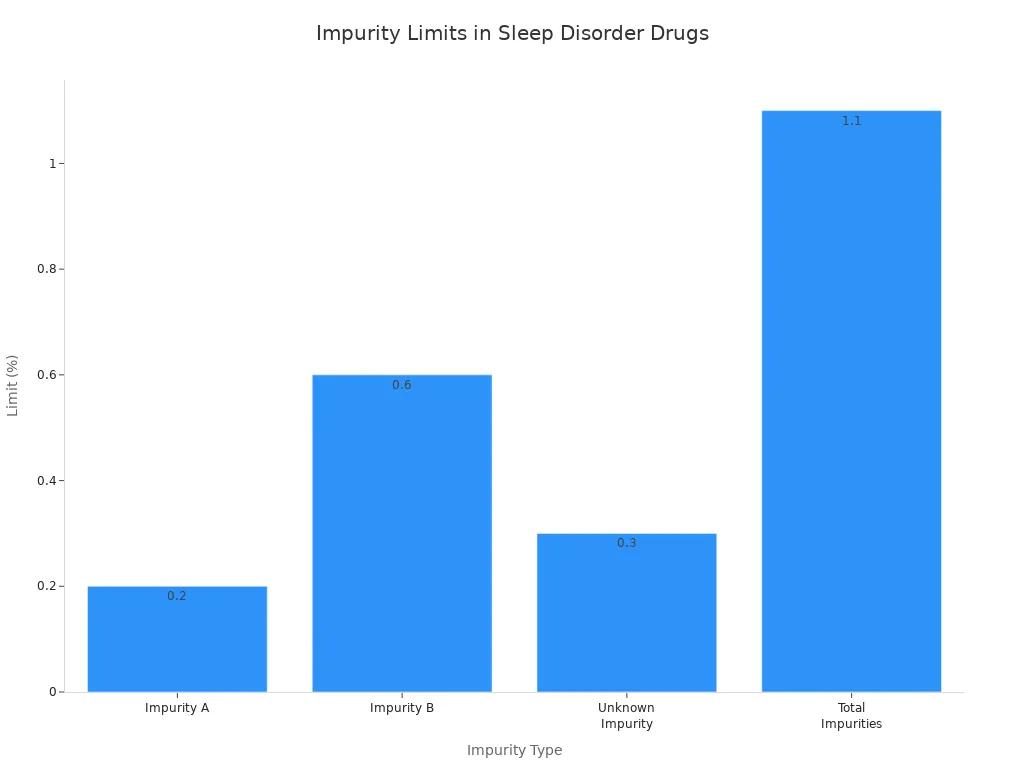
Manufacturers follow industry standards for impurity limits. The table below shows the limits for different types of impurities in sleep disorder medication intermediates:
| Impurity Type | Acceptance Criteria |
|---|---|
| Impurity A | NMT 0.2% |
| Impurity B | NMT 0.6% |
| Unknown Impurity | 0.3% |
| Total Impurities | 1.1% |
| Assay Limit | 95.0% – 105.0% |
You can see that the rules are very strict. This helps protect your health. The production of Suvorexant intermediates uses advanced technology to keep quality high. Scientists test every batch to make sure it meets these standards.
Note: High purity in every pharmaceutical intermediate means safer and more effective sleep disorder treatments for you.
Impact on Efficacy and Safety

Influence on Drug Effectiveness
You want your sleep medicine to work every time you take it. The quality of each pharmaceutical intermediate plays a big role in how well your medicine works. If the intermediate contains impurities, the active ingredient may not form correctly. This can lower the strength of your medicine or make it less stable over time.
When scientists use pure intermediates, they help ensure that the final drug delivers the right effect. You get a medicine that helps you fall asleep and stay asleep as intended.
Impurities can also speed up the breakdown of the active ingredient. This means your medicine might lose its power before the expiration date. You deserve a treatment that remains effective from the first dose to the last.
Ensuring Patient Safety
Your safety comes first in every step of drug production. Impurities in pharmaceutical intermediates can cause serious health risks. Here are some possible dangers:
- Aromatic amine impurities may trigger allergic reactions or harm your liver.
- N-nitrosamines are probably carcinogenic to humans, so even small amounts matter.
- Impurities can lead to regulatory problems and delay drug approval.
- Any impurity present at or above 0.1% must be identified and checked.
Regulatory agencies set strict rules for impurity levels. For example, they limit how much nitrosamine can be in your medicine each day. Scientists must find and remove these impurities before the medicine reaches you.
International guidelines like ICH Q7 and ICH Q11 help keep your medicine safe. These rules require good manufacturing practices and a science-based approach to choosing starting materials. By following these standards, manufacturers protect your health and make sure your sleep medicine meets global quality expectations.
Tip: Always choose medicines from trusted sources. High-quality pharmaceutical intermediates mean safer and more reliable treatments for you.
You play a key role in understanding how a pharmaceutical intermediate shapes sleep disorder treatments. These building blocks ensure your medicine is safe and effective.
- They help scientists create drugs that target sleep pathways.
- High-quality intermediates speed up new discoveries.
- Ongoing research uses versatile intermediates for future therapies.
When you value high-quality intermediates, you support better sleep medicine for everyone.
Post time: Dec-30-2025


